TRAVELING AND CAMPING WITH AUTOHOME ROOF TOP TENT CAMPERS IN NORTH AMERICA... OR ANYWHERE ELSE

Tuesday, March 16, 2010

Water crossing


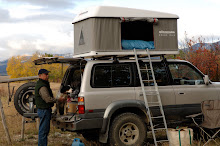
Long-time Maggiolina owner Bob Bancroft send us a photo of a water crossing in Alaska. Naturally, you should not (cannot?) try this at home... 

Bob has been traveling with his Maggiolina for more than a dozen years, and recently bought another for one of his other vehicles. We will be joining Bob for a 8 to 10 day backcountry jaunt in May. Stay tuned.

New Air Top Maggiolina

The new Maggiolina Air Top will be available in Mid-April.

The new Air Top is a significant advance in design – offering ease of opening, three doors, great interior space, and the durability that owners worldwide have come to expect from the Maggiolina series. 


The Air Top has a lift system based on articulated gas rams that eliminates the scissors lift and crank of the standard Maggiolina. This enables easy, rapid set-up and provides 7” more interior space. Other benefits of this new design are; a rear entry door in addition to the two side doors,  the huge window opening the front end of the tent, and a new shell design for extra strength. In short, the Air Top incorporates all the comfort and space of the traditional Maggiolina series with a simple, strong, and easy to operate opening system. To open simply remove the safety hooks and the tent opens instantaneously! 


The new Air Top incorporates all the great features of the traditional Maggiolina series with even more comfort and space. To open, simply remove the latch straps and the tent opens instantaneously! Extreme Adventure with Extreme Comfort!

Standard Air Top Equipment includes: 

3 doors - one each side and one in the rear of the tent

Generous front facing, screened window

Full mosquito netting and covers against wind or rain

Two or three foam pillows

2 arched windows with mosquito netting for ventilation and reduction of condensation

arched zips on the windows with rain covers.

internal elastics straps to help folding of the fabric when closing the tent.

simple, adjustable Rally-Race style locking straps.  (Arnitel EL 550®) 

Spacious roof mounted stowage net.

●     4 Removable Pockets.

Large internal roof mounted light

Height adjustable locking aluminium ladder.

Wednesday, December 30, 2009

Fall Shipment Arrives

We have received the Fall shipment of new AutoHome tents.

So tents - Maggiolina and Columbus models - are available now. This shipment was to have arrived at the end of November but was delayed due to production of new models - but more about that later.

Monday, November 30, 2009

Fiberglass Care

Florida is called the "Sunshine State" for a reason. Because we are traveling so much our Columbus is on our car full time and bearing the brunt of this. It is nice having the shade of the tent, keeps the car much cooler.

I have been noticing something odd. The windshield has some white deposits, like calcium deposits. The tent isn't quite so shiny either, UV damage, chalky gelcoat is sluffing off the tent's roof. Automotive wax is OK but it takes a lot of effort because gel coat is soft and doesn't polish as easily as automotive paint. I'm working with some fiberglass boats so I took a little 3M Fiberglass Restorer and it is easy. Looks like new, but then again it is only a couple years old.

Tuesday, June 9, 2009

New Maggiolina Changing Room

Announcing a new, improved changing room for the Maggiolina series. Available in standard or 4X4 (tall model). These are now on order... prices TBD. 

Thursday, May 7, 2009

Aerodynamics

    The first rooftents we had were these boxy affairs, aerodynamics just wasn't important.  After all, if you were driving much over 55 in your trusty Series Land Rover, you were pushing it.  Today, this has all changed, when Porsche designs a truck for offroad use, aerodynamics is very important.

    You can still get the boxy Maggiolina Adventures by special order.  They are better suited for Africa than North America or Europe.  The new Maggiolinas and Columbus rooftents are designed to be slippery, to allow you to get the best mileage and to travel at high speeds, very high speeds, think German autobahns.  I was surprised by how quiet they are, much quieter than the roof racks.  Seriously, bare racks are noisy, they quiet right down with a Maggiolina or Columbus on them.


    Here is the shape of one of the newer tents.  This is a drawing I got from Italy and it shows something interesting, the flow of air under the tent.  The tents act like a big wing up there.  This was confirmed by some of the guys with G-Wagons and classic Cherokees.  They would tell me that they keep the tents on full time because they get better mileage.  

    Many years ago, I used to have a big Maggiolina Adventure, full boat, as big as they come, even had a rack on top for even more stuff.  This went on my old Volvo wagon, my trusty off-road vehicle at the time, and the mileage suffered.  I went from a constant 22 down to 19 or 20, down at least 10%.  Something was wrong, turns out you don't want a rooftent wider than your car or truck's roof, my tent was way too wide.  There seems to be a funny end plate thing that goes on like at the edge of a wing.  If you get a tent about the same or less width as your roof, the aerodynamics are very good.  When I got a medium Columbus, still a big tent, my mileage went back up to 21 or 22.

    Getting back to the air under the tent.  Turns out, this is a good thing.  Years back, I had to go up to Port Townsend to pick up a large table.  No problem, just break it down and put it on the rack, but then I couldn't carry a rooftent.  My wife will only sleep in a rooftent or a four star hotel, she is a girly girl, hates bugs and loves comfort, so without a rooftent it gets expensive.  My solution was to carry two sets of racks.  The tabletop would go on the low racks, and I had the Columbus on some super high bars at least a foot above the roof.  My guess was that the aerodynamics would suck, but they were actually better, got 22 to 23 mpg on this trip.  It was sitting up there in clear air, looked funny but worked really well.  Another thing I observed, the front of the tent was clean, no bugs.  If you tent is a bug collector, try moving it back if you can, seems to help. 

    We can discuss the aerodynamics of folding fabric rooftents in the next blog entry if anyone is interested.   Let me know.

Rich H

Friday, March 27, 2009

Attaching an Awning to a Maggiolina

Attaching an awning to a Maggiolina isn't difficult, but it is a little confusing. I'm pretty particular in my equipment, it has to be simple, light and work well or it gets left at home. The Maggiolina is a super tent when it really gets nasty and cold, only trouble, sometimes you want to go out in the nastiness and come back in. Here is where an awning comes in handy. I like to have an awning that will not only attach to the tent but is stand alone.

The standard Maggiolina awning works well but I wanted something larger, yeah, really large so I talked to our friends at Mountain Safety Research. Their Outfitter Wing is huge and fits well with a little adapting. Their new Vista Wing is smaller and may be even better. Here is what it looks like sitting flat. A couple things to note about the shape. First, there are no flat edges, they are all curved. What this does is it allows you to tighten up the whole edge so the awning can handle winds very well without flapping. The other thing to note is one side is relatively straight. This is the side that goes next to the tent . At each point is a pocket, so you can run a ridgepole from pocket to pocket. I add a couple grommets along the edge to tie up the ridgepole. More about this later.

Let me show you how the Outfitter Wing looks when set up on a Maggiolina. The awning is huge so you have lots of protected space under, the sides can go to the ground so it will act as a simple side tent if needed. I build a ridgepole that is adjustable in length. The Outfitter Wing is so large that the relatively straight side is longer than the Maggiolina. If you want the ridgepole to sit under the driprail, then you can then shorten it, hence the need for the extra grommets and lines to tie to the ridgepole. This picture shows the ridgepole tucked in under the driprail so you have a nice watertight seal between the tent and awning. When it gets really nasty, it is wise to have the awning tied up to the vehicle as well as to the tent. The tent to awning connection is strong but the awning is so large conditions can overwhelm the connection.


Here are some details on how the connection works. This is an old retrofit we used to do on the old Maggiolinas and will work on new ones too. We make up two long loops out of 1/8 inch braided rope with two small plates attached so you can loop aroung the ridgepole, more on this later. If you look closely at the picture of the Maggiolina, you can see a the loops in place halfway between the doorway and the front and back.


This cutaway drawing shows how the loops are fitted. You can see one of the secrets why the Maggiolina works so well. The fabric isn't attached to the roof directly but is attached to an inner flange. This is why the tent is so well sealed when closed. The loops fit between the fabric and the flange. There is a piece of soft aluminum that the fabric is wrapped around for reinforcement and then riveted to the flange. You need to bend this open slightly and slide the plate through the opening.


Here is a detail showing placement of the loop and plate. Sitting inside the doorway, you reach up and over toward the front and back of the tent. Slide and flip the fabric above the joint down. This will allow you to see the opening and be able to slide one of the plates through the opening to the outside.

I like to put a toggle at the end, the type that are used for cinching up the opening in packs and parkas. REI always has a few in stock. This makes it really simple to tighten up the loops. Put the ridgepole through the loops, tighten the loops using the toggles, that simple. If you are using the awning as sun protection, keep the loops a little loose and have the ridgepole go from pocket to pocket, for maximimum size. If the wind picks up or you want protection from rain then shorten the ridgepole so it will tuck in under the roof's lip. This also allows you to give the awning added support, the straight side is now longer than the ridgepole. Attach lines to the ends and tie to the tent or rack for more protection from the wind.

This same concept can be used to attach other awning systems or side tents to the Maggiolina. One thing to keep in mind, even though the Maggiolina is really strong, awning have a lot of sail area, it is a good idea to take down the awning in high winds.